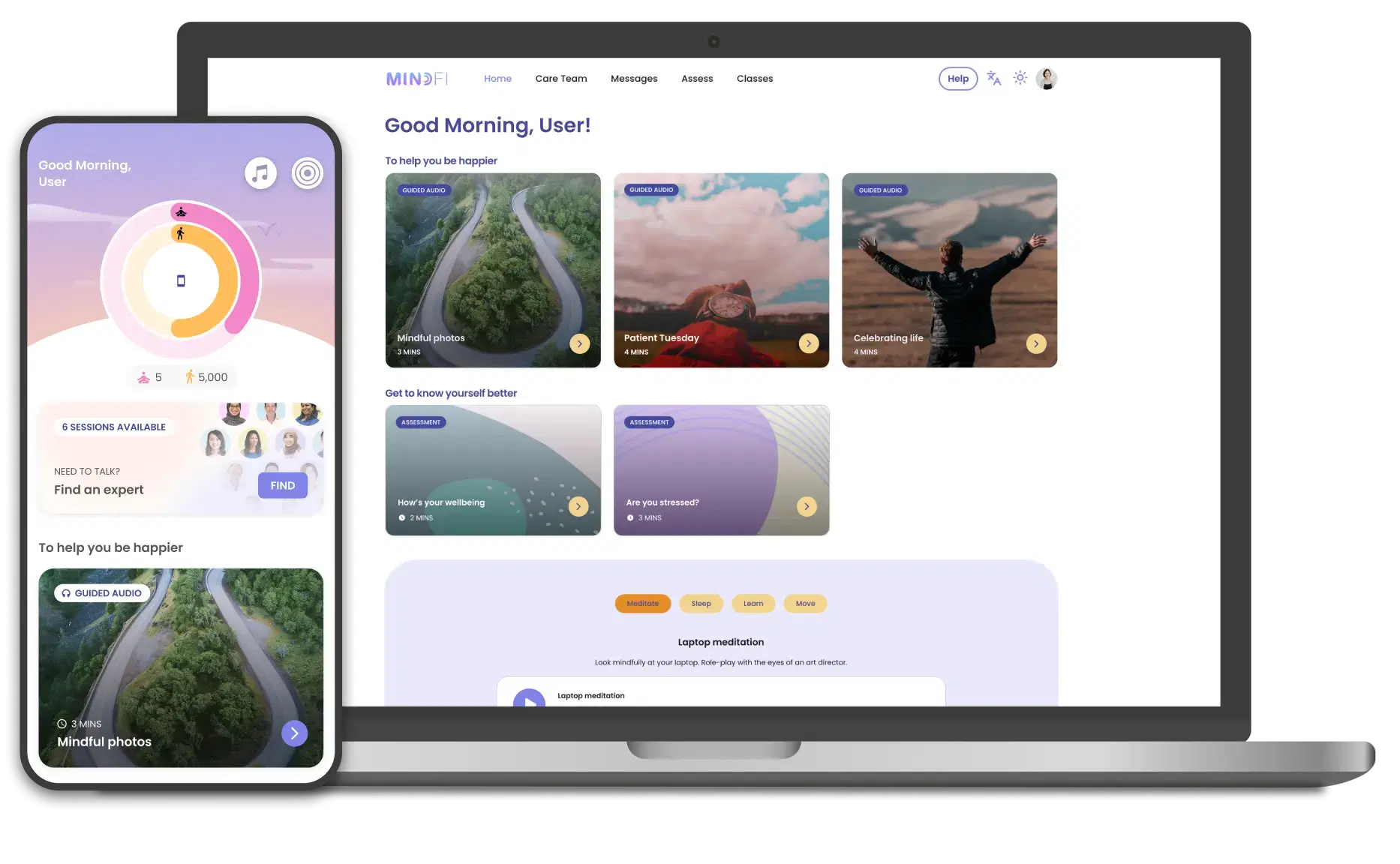

How to Support Workplace Wellbeing Across Multiple Regions (Without Losing Your Mind)

TL;DR
- One-size-fits-all EAPs fail distributed teams. Language gaps, mental health stigma, and flat Western pricing mean the people who most need support in Manila, Hanoi, or Dubai are the least likely to use it.
- Lead with coaching, not crisis care. Productivity, career, and manager coaching lowers the stigma barrier and pulls in high performers. Clinical therapy stays available for those who need it.
- Modern multi-region wellbeing has three ingredients: localized, credentialed practitioners, purchasing-power-calibrated pay-as-you-go pricing, and booking inside Slack or Microsoft Teams.
Why global SMEs are replacing rigid, traditional EAP retainers with culturally nuanced coaching, fair regional pricing, and easy-to-access native workspace support.
The Multi-Region Cultural Complexity Trap
Your head office is in London or Singapore. Your engineers are in Hanoi, your customer success team is in Manila, your sales lead is in Dubai, and your finance function sits in Sydney. On paper, you have a wellbeing benefit. In practice, you have a spreadsheet of regional vendors, three different invoicing cycles, and a nagging suspicion that almost nobody is using any of it.
You're probably right. Multi-region workplace wellbeing is hard because the problem is not one problem but a dozen overlapping ones.

Why Traditional EAPs quietly fail regional teams
Traditional Employee Assistance Programs were built for a single-country, largely western cultured workforce, a 1-800 number, a pool of counselors in one time zone, and a flat annual fee. Applied to a cross-border team, they break in predictable ways:
- Language and context gaps. A generic English-speaking counselor can't easily unpack what "my manager lost face in front of the client" means for a Vietnamese engineer, or the family-obligation pressure a Filipino team lead carries alongside a full-time role.
- Uneven stigma. In many Asian, Middle Eastern, and emerging-market contexts, seeking "therapy" can signal weakness or invite gossip. Even in the UK, Australia, and the US, plenty of high performers avoid anything labelled "mental health" for fear of how it looks.
- Mismatched expectations. Some employees want structured, directive advice. Others want open-ended reflection. Communication norms around hierarchy, directness, and disclosure vary widely, and a single delivery model can't flex to all of them.
The result is a benefit that exists but doesn't get used. EAP utilization has long been reported in the low single digits in many programs, and that is before you account for the extra barriers in cross-border teams. The burden of the problem is not small: the World Health Organization estimates depression and anxiety alone cost the global economy roughly US$1 trillion a year in lost productivity, and about 12 billion working days are lost annually.
The 24/7 air-traffic controller problem
When the formal system doesn't work, the informal one takes over, and the informal one is you.
A team member in Sydney pings you at 9 pm your time because they're overwhelmed. A manager in Dubai asks whether there's "anyone local" they can speak to. A founder wants to know why the wellbeing budget is climbing while engagement scores are flat. You end up manually routing people to fragmented regional providers, chasing invoices in multiple currencies, and trying to remember which vendor covers which country.
For lean HR teams, often one or two people, this is a fast road to your own burnout. You're supposed to be protecting wellbeing, and you're the one who can't switch off. The way out is not working harder at coordination. It is choosing infrastructure that removes the coordination.
The Care Spectrum: Why Coaching and Productivity Are Your First Line of Defense
Wellbeing is broader than crisis care
Ask a room of employees what "wellbeing support" means and many will picture a therapist's couch. That framing shrinks your addressable audience to people who are already in distress and willing to say so.
But most workplace strain doesn't arrive as a crisis. It shows up as:
- Difficulty focusing amid constant notifications
- Blurred boundaries between work and home in remote roles
- Anxiety about feedback or performance reviews
- Cross-cultural communication friction with colleagues in other regions
- A new manager who doesn't know how to lead a team in three time zones
These are performance and wellbeing issues at the same time. Treating them only as clinical problems means most people never seek help until they're depleted.

How coaching destigmatizes support
Here is the practical insight many People leaders have discovered: the label on the door changes who walks through it.
"Therapy" invites hesitation. "Performance coaching," "productivity coaching," or "career coaching" reads as an investment in getting better at your job. In markets where mental health stigma is highest, that reframing matters, and it matters just as much for driven, high-performing employees in Western markets who would never book a counseling session but will happily book time with an ICF-certified coach to sharpen their focus or handle a difficult stakeholder.
Coaching also works as a bridge. An employee who starts with a productivity session often discovers that the real issue is chronic overwork or anxiety, and a good coach knows when to recommend clinical support. Providers and HR teams that lead with coaching commonly report meaningfully higher uptake than therapy-only programs. Measure this in your own data rather than taking anyone's word for a headline multiplier.
Building a balanced care mix
You don't have to choose between coaching and therapy. Coaching and therapy solve different problems. You need both, positioned clearly:
| Support type | Best for | Typical practitioner |
|---|---|---|
| Performance and productivity coaching | Focus, boundaries, feedback, career growth, manager effectiveness | ICF-certified coaches |
| Clinical therapy and counseling | Anxiety, depression, trauma, grief, acute distress | Licensed psychologists and counselors |
The strategic move is to make the coaching door the easy, obvious front entrance, and to make the path from coaching to clinical care seamless when it's needed.
The 4 Operational Rules for Multi-Region Wellbeing
If you take one framework from this article, make it this one. These four rules separate programs that get used from programs that gather dust.
Rule 1: Ensure localized and culturally matched directories
An engineer in Hanoi or Manila deserves a credentialed practitioner who speaks their language, understands local workplace norms, and holds recognized regional credentials, not a generic counselor working from a script.
When evaluating any global employee coaching or culturally sensitive EAP option, ask:
- Can employees filter practitioners by language and country?
- Are practitioners credentialed in the region where the employee actually lives and works?
- Does the directory include local context (industry experience, cultural background), not just a name and a photo?
Brand name matters far less than fit. An employee will only return for a second session if the first felt understood.
Rule 2: Eliminate friction with Single Sign-On (SSO) and workspace integration
Digital-first workers ignore 1-800 hotlines. They also ignore clunky, 1990s-style websites with a multi-page intake form.
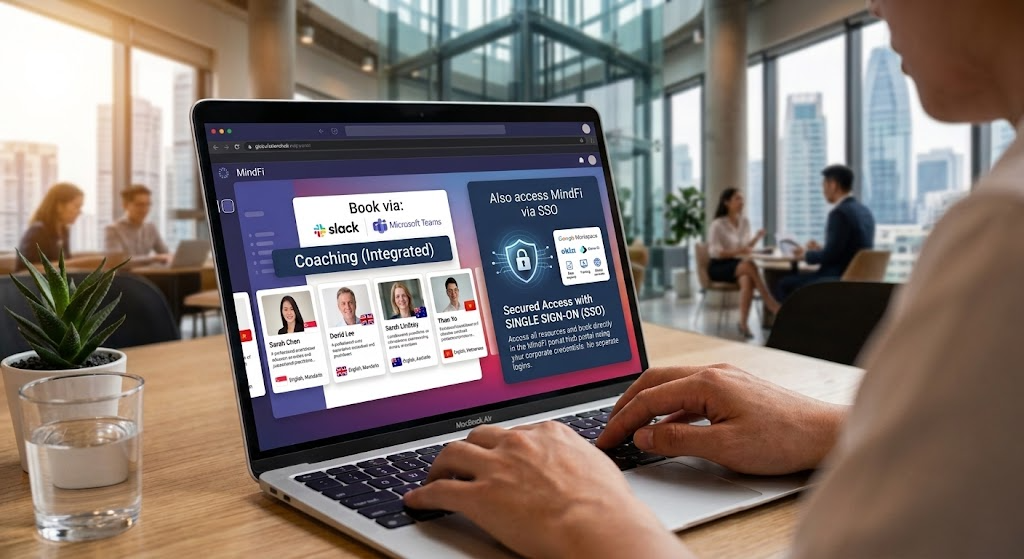
In a modern workplace, access must be effortless and secure. That starts with Single Sign-On (SSO) integration, allowing employees to authenticate instantly with a single click using Google Workspace, Microsoft 365, or other enterprise identity providers. No new passwords to remember, no administrative friction, and total guarantee of privacy.
Equally critical is meeting employees where they open their screens every morning, whether through direct, one-click access links or native tools inside Slack and Microsoft Teams. Asynchronous workplace wellbeing works when booking a session takes under two minutes: authenticate via SSO, find a practitioner, pick a slot, done. No context switching, no tedious forms, and no visible signal to colleagues that anything unusual is happening.
Every extra step between "I need help" and "I've booked help" loses a percentage of people. In a distributed team, where nobody can catch someone's eye across a physical office, a frictionless booking flow is the entire front door to care.
Rule 3: Calibrate rates with purchasing power parity (PPP)
Here is the financial reality nobody likes to say out loud: paying flat western clinical rates for sessions delivered to employees in emerging markets is wasteful.
A session with a qualified practitioner in Manila or Hanoi is priced at local market standards, which is a fraction of what the same hour costs in Sydney or London. If your program charges one blended rate, you're overpaying for regional care, and you're probably under-funding it, because the budget runs down faster than it needs to.
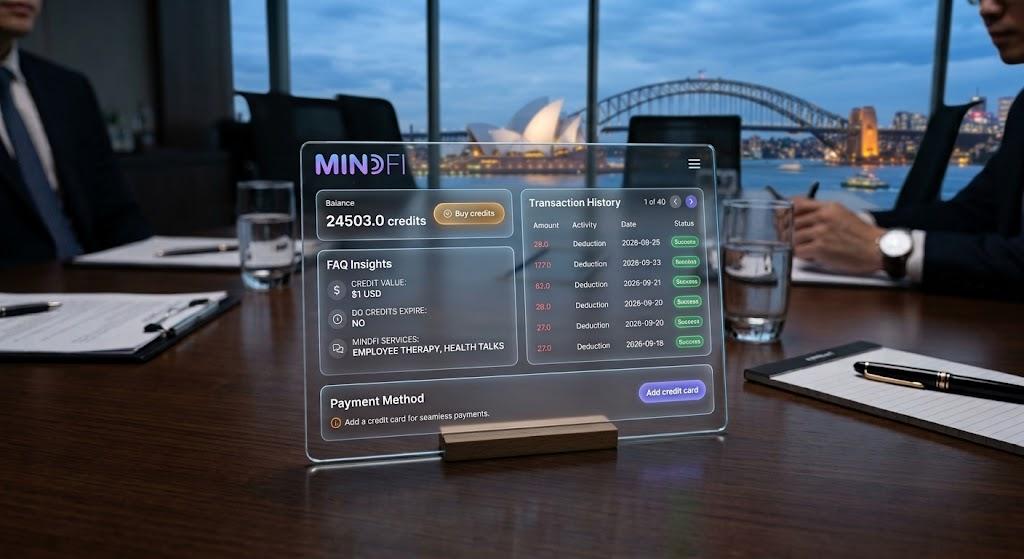
PPP-calibrated credit wallets solve this. Instead of a rigid annual retainer, you fund a pool of credits, and each session's credit cost adjusts to the local market. The same budget then stretches further, and more employees get more sessions. This is the core logic behind a pay-as-you-go EAP: you pay for care that is actually delivered, at a fair regional price, instead of prepaying for utilization that never comes.
For your CFO, that is a much easier conversation than defending a fixed retainer with single-digit uptake.
Rule 4: Empower managers across cultures
Managers are the multiplier. An employee's first signal that "it's OK to ask for support" usually comes from their direct manager, and managers in different regions signal it very differently.
Regional group workshops on burnout prevention, boundary-setting, and culturally aware leadership give managers a shared vocabulary without forcing a single cultural script on everyone. A manager in Singapore, one in the UK, and one in Dubai will not lead identically, and they shouldn't. But all three can learn to spot early warning signs, hold a supportive conversation, and point people to the right resource.
Legacy Retainer EAPs vs. Modern Multi-Region Wellbeing Platforms
| Dimension | Traditional Global Retainer EAP | Modern Multi-Region Wellbeing Platform |
|---|---|---|
| Pricing model | Flat annual retainer or per-head fee, often multi-year; the same rate regardless of country | Pay-as-you-go credit wallets, PPP-calibrated by region; low or $0 base fee options |
| Regional care directories | Centralized pool, often western-cultured; limited local-language coverage | Localized directories by country and language with regionally credentialed practitioners |
| Cultural nuance and stigma bridge | Generic, one-size-fits-all messaging; therapy-first framing | Culturally matched practitioners; coaching-led entry point that reduces stigma |
| UX and booking channel | Phone hotline and separate web portal with its own login | "3-click" booking with SSO or natively within workspaces like Slack and Microsoft Teams |
| Scope of support | Primarily short-term counseling and crisis support | Full spectrum: performance, productivity, career and manager coaching, plus clinical therapy |
| Setup and commitment | Lengthy procurement, contract negotiation, and onboarding | Self-serve launch, often within a day; no long-term lock-in |
| Cost visibility | Pay upfront regardless of use | Pay for sessions delivered, with clear credit tracking |
What This Looks Like in Practice
The pattern across forward-thinking SMEs is consistent: they stop trying to stitch together regional vendors and instead adopt a single platform built for distributed teams.
MindFi is one example of this modern framework for employers. SMEs use it to deploy localized regional directories (Singapore, the UK, Australia, the UAE, Hong Kong, Southeast Asia and over 60 countries), SSO, workspace integrations and pay-as-you-go coaching and clinical therapy services that can get set up in under 24 hours. There is also a $0 base platform fee option, which matters for a practical reason: HR leaders can test the model with a small credit wallet or a credit card on file, see real utilization data, and make the case internally without needing upfront CFO sign-off or committing to a multi-year contract.
That last point deserves emphasis. The biggest barrier to fixing your wellbeing program is rarely the idea. It is the procurement cycle. Infrastructure that lets you start small and prove value removes that barrier.
The Bottom Line
Supporting a distributed workforce doesn't require heroic effort from an overstretched HR team. It requires the right infrastructure: culturally matched practitioners, a coaching-first front door, fair regional pricing, and booking that lives where your people already work.
If you want to see how that works without a long procurement process, start a free MindFi account today, add a credit card, and give your distributed team instant access to modern, culturally tailored workplace wellbeing.
Start small, watch the utilization data, and build the business case from real results.
MindFi Team
MindFi Team
The MindFi team consists of mental health professionals, workplace wellness experts, and technology specialists dedicated to making mental health support accessible and effective for everyone.
Credentials
This article is educational and not a substitute for medical or mental health diagnosis or treatment. If you need personal care guidance, consult a licensed professional.
Don't miss our latest articles
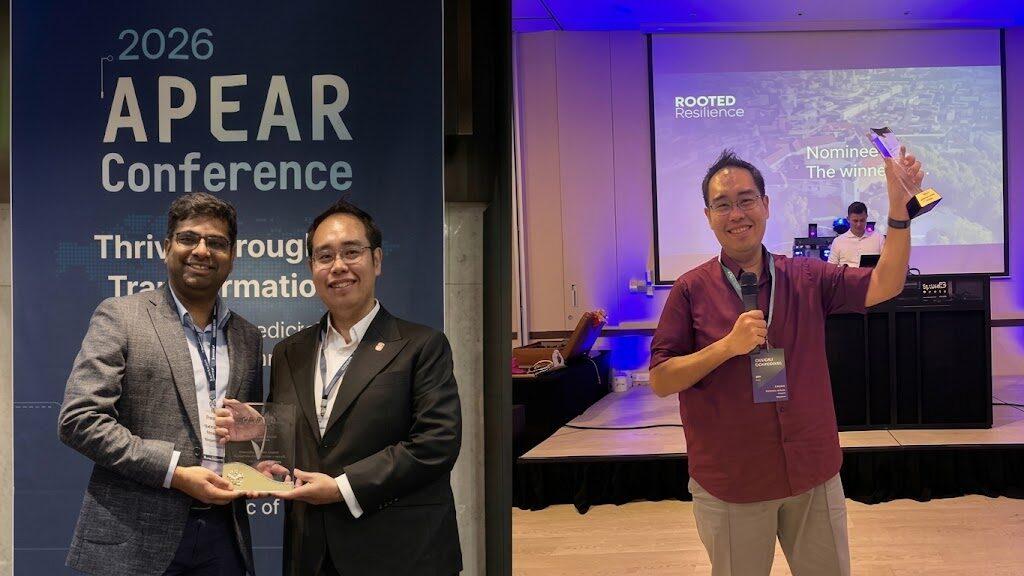
2-for-2 on the World Stage: How MindFi Won Top Employee Assistance Innovation Honors in APAC and Europe
MindFi wins top EAP Innovation honors at both APEAR 2026 and EAEF 2026. Discover the award-winning platform synchronizing global employee mental health.

The Hidden Question Beneath Workplace Stress
Workplace stress may be about more than workload. Explore how purpose, values, meaning and fulfilment can influence stress, motivation and wellbeing.

Investing in Survival: Your Guide to True Psychological Self-Care
True self-care goes beyond luxury spas and shopping. Learn how simple, daily habits can protect your mental health and prevent burnout.